
The Gig You Posted Isn't Getting Orders — Here's Why
Quick Answer
Generic "I write ChatGPT prompts" gigs are getting buried on Fiverr and Upwork because anyone with a free ChatGPT account can offer the same thing for $5. Clients stopped buying prompts and started buying outcomes — a specific result, proof it works, and someone who can fix AI output when it's wrong. This guide explains exactly why the old pitch stopped working and how to reposition your existing gig without starting over.

You posted the gig two weeks ago. "I will write ChatGPT prompts for you." Clean title, decent thumbnail, priced at $5 to get your first reviews. You checked back yesterday.
Zero orders. Zero clicks, probably. Your gig is sitting on page four of Fiverr's search results, right next to about four thousand identical ones.
Here's the thing nobody tells you: it's not you. It's not your writing, your niche, or bad luck. Why AI prompt writing doesn't get clients anymore comes down to one boring, unglamorous fact — you're competing against every single person who has ever opened ChatGPT, and the client can't tell you apart from them.
Why Isn't Your "I Write ChatGPT Prompts" Gig Getting Any Orders?
Picture the client's side of this for a second. They search "AI prompt writing" on Fiverr. They get a wall of gigs that all say some version of the same sentence. Half of them are $5. None of them show a result — just a promise that the seller "knows how to talk to ChatGPT."
The hype version of this pitch is "become a prompt engineer and make $100k from home." The real version is a $5 gig sitting between three hundred other $5 gigs, all invisible to a client who has no way to tell which one is actually good.
That's the core problem: prompt writing isn't a scarce skill anymore. In 2023, knowing how to phrase a request well genuinely got you a better result than someone who didn't. By now, the AI tools themselves have gotten a lot better at understanding plain, messy instructions — you don't need a clever phrase, you just need to say what you want. The "magic wording" trick that used to be worth paying for mostly stopped mattering, because the model doesn't need the trick anymore.
So the client isn't wrong to skip your gig. They're not being difficult. They just don't see a reason to pay for something they can now do themselves in the same chat window they already have open.
What Actually Happened to the AI Prompt-Writing Market in 2026?
Here's a comparison that'll make this click: remember when "I know how to write meta tags for SEO" used to be an actual, sellable freelance service? It was, for about a decade. Then Google got better at understanding pages without perfectly-optimized meta tags, and that narrow skill quietly folded into a bigger job — "SEO specialist," "content strategist," something broader that included meta tags as one small piece of a bigger toolkit.
Prompt writing is going through the exact same thing, just faster. The standalone skill of "I can phrase a good ChatGPT prompt" isn't gone — it just stopped being enough on its own. It's been absorbed into bigger, better-paid roles: people who build entire AI workflows, people who catch and fix AI mistakes before a client ever sees them, people who specialize in one industry and know exactly what that industry needs an AI tool to do.
This matters for you because it changes what you're actually supposed to be selling. You're not competing in a shrinking market. You're standing in the wrong aisle of a market that's still growing.
What Are Clients Actually Paying For Instead of Prompts?
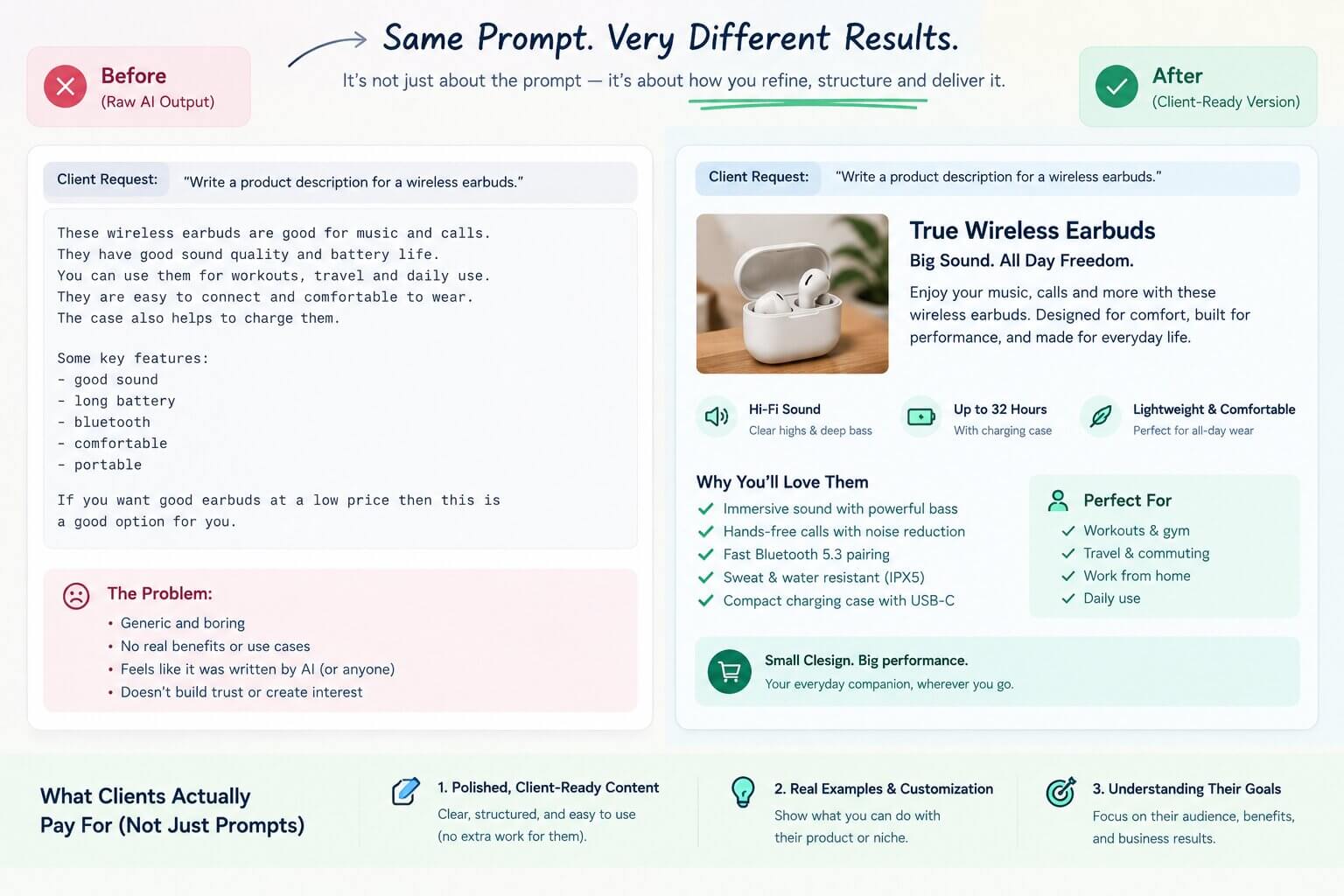
If "I write prompts" doesn't work anymore, what does? Three things, consistently — and none of them require starting from scratch.
A Specific Niche, Not a Generic AI Skill
"I use AI to help businesses" tells a client nothing. "I use AI to write product descriptions for small Etsy jewelry shops" tells them everything — including that you understand their exact problem well enough that they don't have to explain it to you. The narrower your gig sounds, the more it reads as expertise instead of a hobby.
Proof of an Outcome, Not a Prompt Sample
A client doesn't want to see the clever question you asked ChatGPT. They want to see the before-and-after: the messy first draft of their email versus the version you cleaned up, the confusing product page versus the one that actually converts. One good before/after example does more for your gig than ten paragraphs describing your "prompt engineering process."
Someone Who Can Fix AI Output, Not Just Generate It
This is the one most beginners miss. AI tools generate a first draft fast — that part's basically free now. What's still genuinely worth paying for is someone who can look at that first draft and know what's wrong with it: wrong tone, made-up facts, a structure that doesn't match how the client's customers actually think. That judgment call is the service. The prompt is just the first step of it.
What does this pivot actually pay? Once a repositioned gig is working consistently, freelancers offering this kind of outcome-based AI service typically land in the $300–$1,500/month range on Fiverr and Upwork, depending on how niche the offer is and how many hours go into outreach each week. That's not a guarantee — it's the realistic band once the gig itself is actually attracting clicks.
How Do You Fix a Dead Gig Without Starting From Zero?
You don't need to delete your gig and start over. You need to rewrite what it says, and shift what you're showing as proof. Here's the order to do it in:
- Rewrite your gig title around an outcome, not a tool. Replace "I will write ChatGPT prompts for you" with something that names the actual result — "I will turn your messy product descriptions into ones that convert" beats any sentence with "ChatGPT" in it.
- Pick one niche and say it out loud in the title. Not "for businesses." For dentists, for Etsy sellers, for local gyms — whatever you actually understand. A narrow gig with real orders beats a broad one with none.
- Replace your gig images with a before/after, even a rough one. Take a real (or realistic mock) example and show the messy input next to the cleaned-up output. This single change usually does more than any amount of description rewriting.
- Add one sentence about fixing AI mistakes, not just generating text. Something like "I also catch the errors AI tools miss" signals judgment, which is the part that's actually scarce right now.
- Reprice above $5. A $5 price tag signals "commodity" to a client browsing a hundred identical gigs. Once your title and proof are specific, price like it — even a modest jump to $25–$50 changes how the gig reads.
This doesn't require new tools, new certifications, or a new platform. It's an afternoon of editing an existing gig, done properly.
Realistic Expectations: What Happens After You Fix Your Gig?
Here's the part the gurus skip. Rewriting your gig doesn't flip a switch. Most people who do this see $0 in the first week or two — Fiverr and Upwork both take time to re-index a changed gig, and buyers don't appear the moment you hit save.
Realistic month 1 after a genuine repositioning: $50–$300, mostly from smaller, lower-priced first orders while you're still building reviews. That's normal. It's not a sign the pivot failed.
The people who stick with it — refining the niche, adding a second before/after example, sending a few direct outreach messages instead of just waiting for the algorithm — typically move into the $300–$800/month range by month three. Getting there takes maybe 3–5 hours a week: an hour rewriting and testing gig copy, the rest split between doing the actual work and a bit of outreach. It's not a weekend flip. It's a slow, unglamorous climb, and that's the honest version — not the one on the thumbnail.
If you're weighing whether this kind of service work is even the right lane for you versus something like selling AI-made products, it's worth comparing service and product income first before you sink a month into gig rewrites.
Fiverr's flat 20% platform fee and Upwork's sliding 5–20% fee both eat into these numbers — worth knowing how Fiverr's fees compare to other platforms before you settle on where to sell.
Frequently Asked Questions
What to Do Right Now
Open your current gig and rewrite the first line to name one specific outcome instead of "I write ChatGPT prompts" — no new tools, no new account, free, and doable in the next ten minutes.
KEEP READING
Want the wider picture of what a beginner can realistically earn?
See what a beginner can realistically earn with AI in the first 30 days, and where this pivot fits into the wider AI earning roadmap.
This is a Level 2 guide. If your gig isn't dead but you're still hitting other early AI-earning pitfalls, see the other AI money traps beginners fall into.
Join the discussion
Sign in to leave a comment or reply
No comments yet
Be the first to share your thoughts!