
Service Income vs Product Income — The Decision That Shapes Everything
Most people who want to make money with AI eventually face the same question: should they offer a service — do work for clients and get paid — or should they build a product — create something once and sell it repeatedly?
This is one of the most important early decisions you'll make, and most people get it wrong. Not because they chose a bad option, but because they chose based on what looks most appealing instead of what actually fits where they are right now.
Service income vs product income is not a question of which one is better in general. It's a question of which one is right for your current situation, your time, and your stage.
Why This Decision Matters More Than Most People Think
The income model you start with shapes everything else — how fast you earn, what you learn, how much effort the early months require, and how long before you see any results.
Most beginners choose their starting model based on one thing: which one sounds better. And almost always, products sound better. Passive income, scale, the idea of earning while you sleep. Services, by comparison, sound like work — meetings, clients, deadlines, delivery.
So beginners choose products. They spend two or three months building something, publishing it, and wondering why nobody is buying. The uncomfortable truth: what sounds best and what works best for a beginner are often two different things.
Why Products Look Attractive vs. What They Actually Require First
Most beginners choose products before they have the assets products need. Services build those assets faster.
Products scale well. Services teach faster. Most durable businesses start with services.
What Service Income Actually Is
Service income means you perform a specific task, deliver a specific result, and get paid for it.
You identify a problem → You solve it using AI tools → The client pays for the result.
In the AI income world, service work includes:
- Writing blog posts, captions, or email sequences for businesses using AI to work faster
- Creating thumbnails, social media graphics, or presentation slides using AI design tools
- Producing competitor research reports, topic summaries, or market analysis documents
- Editing and repurposing long-form video content into short clips
- Setting up basic AI automations or workflows for small business owners
The major advantage of service income early on is feedback speed. When you deliver work for a real client, you find out almost immediately whether it's valuable. They accept it, request changes, come back for more, or don't. Every response is data that makes your offer better.
What Product Income Actually Is
Product income means you create something once and sell it multiple times.
You build an asset → You distribute it → Someone buys it → You earn without repeating the work.
In the AI income world, products include:
- Prompt packs: curated, ready-to-use prompts for a specific job or industry
- Canva or Notion templates: pre-built systems people can download and use immediately
- Mini ebooks or PDF guides: short, focused information products on a specific topic
- AI workflow libraries: documented systems showing how to use AI for a repeatable process
- Short courses or video trainings: teaching a skill or method in a structured format
According to one analysis of Udemy, the average instructor makes around $3,306 per year, with 75% of instructors making less than $1,000 a year. The top earners have established audiences and distribution that took years to build. This is not a reason to avoid products — it's a reason to sequence them correctly.
Digital Product Income Distribution — Who Actually Earns What
Data from Udemy (largest online course platform). The pattern holds broadly across Etsy, Gumroad, and other digital product platforms.
$3,306
Avg. Udemy instructor earnings/year
75%
of instructors earn less than $1K/yr
1%
earn more than $50K/yr on Udemy
50%
of all earnings go to the top 1%
Loading chart…
Source: Sell Courses Online independent study of Udemy earnings data. Pattern applies broadly across digital product platforms.
When Services Make More Sense
Services are usually the better starting point when one or more of these is true:
You need income within the next 30 to 60 days.
Services are the only model that can reliably produce payment in that window. Products require build time, then marketing time, then conversion time. That sequence rarely fits inside two months for a beginner.
You have no existing audience.
Products require someone to find and trust you. If you're starting from zero followers and zero email list, building the distribution needed for product sales is a separate multi-month project. Services bypass this — you go find one client directly.
You have limited hours per week.
Building a product business properly takes consistent hours across many weeks. At 3–5 hours a week, a targeted service offering is much more manageable.
You're still figuring out what people actually pay for.
Every client interaction teaches you something — the language people use to describe their problems, the objections they raise, the results they care about. That knowledge is the foundation that makes products work later. Without it, products are guesses.
When Products Make More Sense
Products become the smarter choice when you have already built some of what they require:
You keep solving the same problem repeatedly.
If you've delivered the same type of work 10–15 times using the same process and prompts every time — that's a product. The work is already done. You just need to package it.
Clients keep asking you for the same things.
When multiple clients ask for the same resource — a template, a checklist, a prompt set — that's market validation in real time. They're telling you what product to build. This is a dramatically better position than guessing.
You've reached a time ceiling with services.
Services scale up to a point, then stop. When your service work is full and you can't take more clients without compromising quality, that's the right time to start converting your process into a product.
You have an existing audience, even a small one.
A newsletter with 200 subscribers, a social media following in a specific niche, or an active online community presence gives products something to launch into. Even small trust networks make a meaningful difference.
Why Passive Income Is Usually Misunderstood
The idea that drives most people toward products is passive income. It's a legitimate goal — but the version most beginners imagine doesn't reflect how it actually works in practice.
Products require significant work to build. They then require consistent effort to market, distribute, and improve. Most digital product creators spend substantial weekly hours maintaining and promoting their products long after the initial build. The income can become semi-passive over time, but it rarely becomes fully passive in the early stages.
Think of product income as delayed leverage, not instant freedom.
You do the work now, repeatedly, and the leverage shows up later — when sales accumulate, when search traffic builds, when word-of-mouth kicks in. That leverage is real and genuinely valuable. But it arrives on a timeline of months to years, not days.
Almost nobody builds a successful product business without first doing the service work that taught them what the product should be.
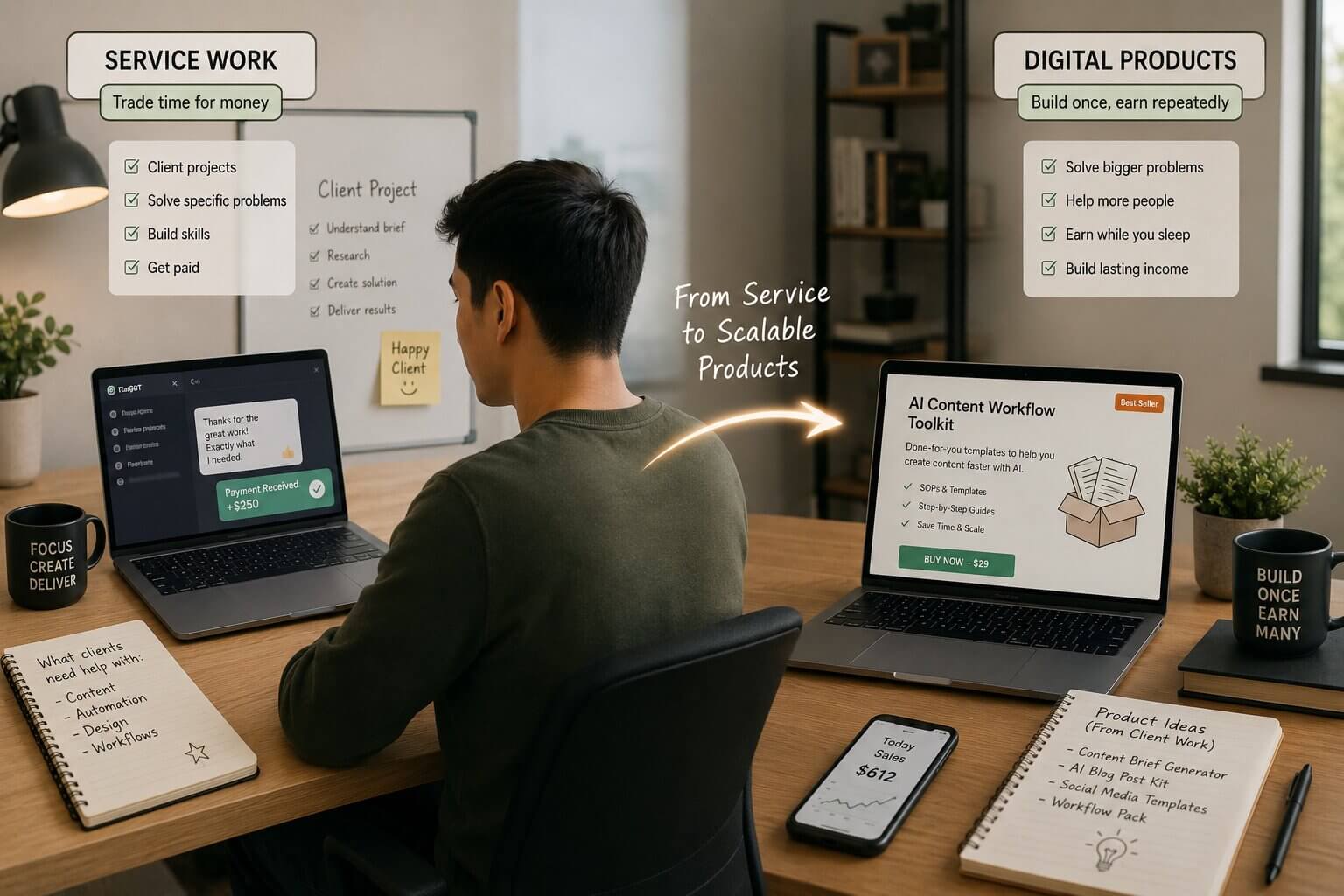
The Smarter Sequence: Services → Products
The most durable AI income businesses don't choose between services and products — they use both, in sequence. Services come first to generate income and learning. Products come later to scale what the services proved worked.
Deliver services and get paid.
Pick one service, find clients, deliver consistently. The goal at this stage is not just income — it's insight. What do clients ask for repeatedly? What takes the most time? What do they value most?
Standardize what works.
After delivering the same type of work multiple times, you start building internal tools — your own prompt library, templates, and process documents. These are the raw material for products.
Package your process into a product.
The templates you built for yourself become a product someone else can buy. The prompts you refined across 20 projects become a prompt pack. You're not guessing what to build — you're packaging what already works.
Build distribution alongside the product.
A blog, an email list, a social presence, or a community gives your product an audience to launch into. This can be built in parallel with service work, or started after your first product.
The Service → Product Progression
You don't have to choose services or products. You sequence them.
Deliver
Get clients, earn income, learn what they really need
Standardize
Build your own prompts, templates, and process docs
Package
Turn your process into something someone else can buy
Scale
Grow the audience that makes products easier to sell
61%
retention rate for freelancers who land a client in month 1
Upwork 2025
40%
more per hour for AI-enabled vs traditional freelancers
Upwork Research
2–4 mo
typical time for first consistent digital product sales
Industry Average
The 90-Day Income Roadmap
If you're starting from zero, here's the sequence that gives you the best chance of real results in the first three months.
Focus entirely on earning
Pick one service. Find clients. Deliver work. Get paid. Do not build a website. Do not design a logo. Do not set up automation. Do not research products.
🏁 Goal: At least one real client paying you for real work. Everything else is a distraction until that proof exists.
Focus on pattern recognition
You now have some client experience. What kept coming up? What were clients happiest with? What took the longest but mattered least? What do you wish you had a template for?
🏁 Goal: Find the patterns inside your service work. You're not building anything yet — you're noticing what repeats.
Begin packaging
Take the most repeated part of your service work and turn it into a simple asset. A one-page template. A prompt set. A workflow document. This is your first product prototype — not launched publicly yet, just something that exists and could be sold.
🏁 Goal: By day 90, an active service income and a first draft of a product built on real client insight.
Mistakes That Slow You Down
So Which One Should You Pick First?
Here's the honest, practical answer — based on your current situation:
| Your Current Situation | Better Starting Model |
|---|---|
| Need money within 30 to 60 days | Services |
| No existing audience | Services |
| Under 8 hours per week available | Services |
| Just starting out, no client work yet | Services |
| Already have repeat clients | Products |
| Keep solving the same problem repeatedly | Products |
| Have an audience, even a small one | Products |
| Hit a time ceiling with service work | Products |
The pattern is clear. For most beginners, services are the right starting point. Not because products are bad, but because services give you the income, the speed, and the client insight that makes products work later.
Digital products are the future, but freelancing is the bridge.
The bridge gets you across first. Then you build what you learned on the other side.
You don't need to choose your forever model today. You only need to choose your next step. If you're early, start with services. If you're already repeating the same work for clients, start packaging it. If you're building traction, start growing your distribution.
The goal is not the perfect model. The goal is momentum — and momentum comes from starting where feedback arrives fastest. For most beginners, that's the services path.
Frequently Asked Questions
CONTINUE THE SERIES
What a Beginner Can Realistically Earn With AI in 30 Days
You know which model to start with. Now see the realistic income numbers — broken down by service type, effort level, and week by week.
Part of the series: Which AI Income Path Is Right for You? · Previous → The Fastest Path to Earning Your First Dollar With AI · Next → Realistic AI Earnings in 30 Days
Join the discussion
Sign in to leave a comment or reply
No comments yet
Be the first to share your thoughts!