
Upwork Just Admitted AI Already Ate 10% of Its Business
Quick Answer
Upwork’s own 2026 earnings reports say AI is now displacing an estimated 10% of the work on its platform — almost all of it in gigs under $500. Fiverr shows the same pattern from a different angle: fewer buyers overall, but the ones who stay are spending more on bigger, more complex projects. Neither platform is dying. The cheap, generic-task tier of both is dying. That’s actually workable news if you’re starting now — as long as you don’t aim for the tier that’s disappearing.
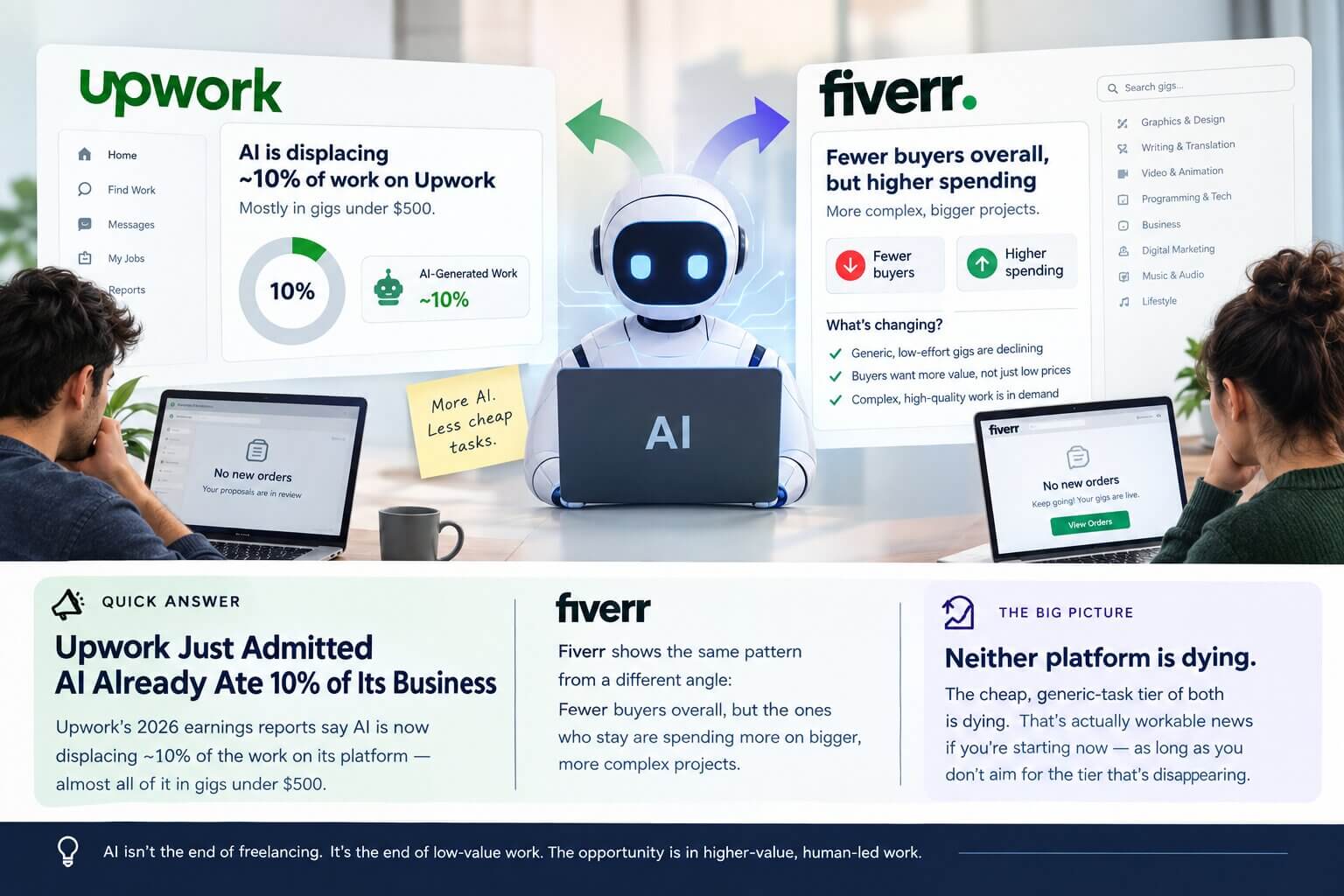
In May 2026, Upwork cut about a quarter of its own staff. The reason the company gave — in its own earnings call, on the record — wasn't "the economy" or "a routine restructuring." It was AI.
If you've spent any time on Upwork or Fiverr, the two biggest places online to find freelance work, you've probably seen a version of this headline a dozen times this year: AI killed freelancing. That's the hype version. The real story of how AI disrupted Fiverr and Upwork is more specific than that — and more useful, if you're actually trying to decide whether to start freelancing right now.
What Did Upwork Actually Say About AI in Its Own Earnings Report?
Here's the part most headlines skip entirely: the actual numbers, in Upwork's own words.
In its Q1 2026 earnings report, Upwork posted about $195 million in quarterly revenue, cut its full-year revenue outlook, and announced it was reducing its workforce by roughly 24% — about 145 jobs — with $16–23 million in one-time restructuring costs. The company tied all of it to AI changing the shape of demand on its platform.
Buried in the details, Upwork's own team estimated that tasks representing about 10% of its platform's GSV are now "AI at-risk." (GSV stands for Gross Services Volume — the total dollar amount of work moving through the platform before Upwork takes its cut. Think of it as the platform's total sales, not its profit.) That pressure isn't spread evenly. It's concentrated almost entirely in contracts under $500 — the small, well-defined, quick-turnaround jobs that used to be Upwork's bread and butter for beginners.
Upwork also said demand slowed noticeably from late February through early April 2026 — right around the time clients started leaning harder on tools like ChatGPT and Claude (two AI chatbots — from OpenAI and Anthropic — that can draft, edit, and organize written work in seconds) to just do the small task themselves instead of hiring someone.
The hype version of this headline is "Upwork admits AI is destroying freelancing." The honest version: Upwork admits AI is destroying one specific, cheap tier of freelancing. That's a very different problem, and it has a very different answer.
Is Fiverr Seeing the Same Thing, or Is This Just an Upwork Story?
Fiverr — the other major freelance marketplace, built around fixed-price "gigs" instead of Upwork's proposal-and-bid system — reported its own Q1 2026 results about a week before Upwork did. The pattern lines up almost exactly, just more extreme.
Fiverr's active buyers dropped by close to 18%. But the buyers who stuck around spent over 15% more per person. Total gig revenue (the transactional, order-by-order side of the business) fell close to 14%, while Fiverr's other revenue — subscriptions, advertising, and add-on services — grew 30%. Fiverr had already cut about 30% of its own workforce back in September 2025, also citing AI.
Translate that out of earnings-call language: fewer people are buying tiny, cheap gigs on Fiverr. The people still buying are spending more, on bigger projects. Fiverr itself is leaning into this — its leadership described the shift as moving "from a transactional marketplace to a sophisticated work platform," and pointed out that projects over $1,000 are now growing at a double-digit rate.
One quick practical note while we're comparing the two: Fiverr takes a flat 20% cut of everything you earn. Upwork's fee is tiered — 20% on your first $500 with a client, dropping to 10% and then 5% as you work with that client longer. It's a small detail, but it matters more once you're deciding where to build a repeat relationship with a client.
The Part Every Headline Skips: What's Actually Growing While the Cheap Work Disappears
Here's the twist nobody puts in the headline: while the cheap tier shrinks, a different part of both businesses is growing fast.
Upwork's AI-related work grew more than 40% year over year and now adds up to over $300 million a year in GSV. Fiverr's $1,000+ projects are growing at a double-digit rate, with 18% more clients placing orders at that size. Both companies are explicitly betting their futures on this shift. Upwork launched an AI assistant called Uma — built into the platform to help businesses write job posts, shortlist freelancers, and summarize a freelancer's work history — and even built an app inside ChatGPT itself, so a business can find and hire a freelancer without ever leaving the chat window they're already working in.
So here's the honest version of "AI killed freelancing," in the platforms' own words: we're shrinking the cheap tier on purpose, and charging more for what's left.
That's genuinely useful information if you're a beginner. It tells you exactly which direction not to walk in.
For more on why this whole AI-income window opened up in the first place — the six broader shifts behind it — see why this AI income window opened in the first place.
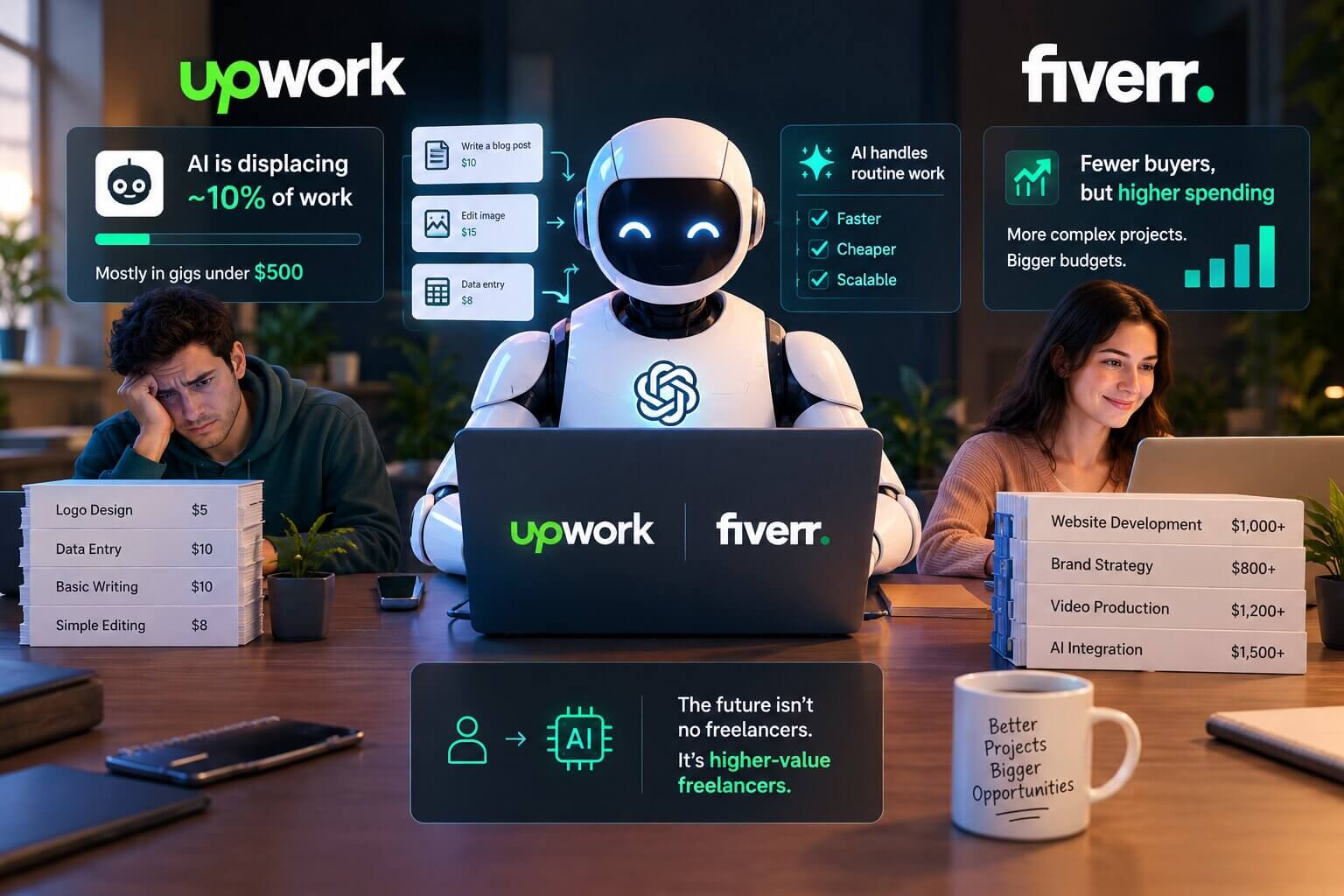
Which Freelance Work Is Actually Disappearing — and Which Is Growing?
Let's turn the earnings-call language into an actual list, because "AI-at-risk tasks" isn't something you can act on.
Disappearing (the commodity tier — avoid building here):
- Generic blog posts or articles with no research, angle, or strategy attached
- Basic data entry and simple spreadsheet cleanup
- Templated social media captions with no brand voice or strategy behind them
- Simple logo variations or one-off graphic tweaks
- Plain transcription with no editing or formatting judgment
- Virtual assistant work that follows a fixed, repeatable script
Growing (the complex tier — aim here instead):
- SEO strategy and content planning — not "write me 10 articles," but figuring out what to write and why
- Copywriting that requires real subject-matter expertise (finance, health, legal, technical products)
- Building AI-powered workflows or automations for a specific business's actual process
- Ongoing social media strategy — managing a brand’s voice and calendar over time, not just posting
- Custom AI chatbot setup for a business's specific customer questions
- Video editing with creative direction, not just cutting clips to length
- Consulting-style engagements where a client is paying for your judgment, not just your hands
A realistic starting range for the surviving tier: $50–$300/month in your first 1–3 months, growing to $300–$1,500/month by month 3–12 if you stay consistent. That range assumes the complex tier. The commodity tier is increasingly worth close to nothing, because a client can just open ChatGPT or Claude and do it themselves for free or a few dollars a month — the exact thing Upwork's own data shows already happening.
If you're still deciding whether service-based freelance work is even the right model for you versus building a product, whether service income is even the right model for you walks through that decision.
I Only Have 5 Hours a Week After My Day Job — Is This Still Worth Starting?
Yes. And this section matters more than any other one in this guide, because it's probably you.
Here's the math nobody bothers to do: the commodity tier that's disappearing was always a volume game. It rewarded whoever could send the most proposals, take the most orders, and turn work around the fastest. If you only have 5 hours a week, you were never going to win that race anyway — not because of AI, just because of arithmetic. Someone freelancing 40 hours a week could always out-produce you on cheap, repeatable gigs.
The complex tier works completely differently. It rewards depth, not hours logged. One well-scoped project that solves a real problem for one client beats twenty rushed, cheap gigs — and one well-scoped project is something 5 hours a week can actually deliver.

Here's a realistic way to split those 5 hours:
- 1 hour — positioning and outreach: refining who you help and what specific problem you solve, and reaching out to 2–3 potential clients
- 3 hours — actual delivery work on a current project
- 1 hour — client communication: updates, questions, next steps
Be honest with yourself about the pace: at 5 hours a week, realistic income in your first 90 days is closer to $0–$150 — slower than what someone going full-time would see. That's not a discouraging number, it's an accurate one. Slower and sustainable beats fast and burned-out, especially when you're doing this alongside a full-time job.
If you're starting with genuinely no freelance experience at all, starting with zero freelance experience is a good next stop before you build your first profile.
Realistic Expectations: What This Actually Looks Like Month by Month
The guru selling you a course about "$5,000/month freelancing with AI" made his $5,000 selling the course — not doing the freelancing. Here's the honest version instead.
- Month 1: Likely $0. This month is profile setup, positioning, and figuring out exactly what complex-tier service you're offering. That's normal, not a failure.
- Month 3: Your first client or two, typically in the $50–$300 range total, assuming consistent effort.
- Month 6: $300–$800/month if you've stayed consistent — more if you're able to put in full-time hours instead of 5 a week.
If you're working 5 hours a week instead of full-time, stretch these timelines out — expect month 3's results closer to month 5 or 6. That's the honest trade-off of doing this part-time, not a sign you're doing it wrong.
For the full range of AI-powered side hustles beyond freelance services — content, products, and more — see the full list of AI side hustles beginners can start with, and for a complete step-by-step path, the full AI income roadmap.
Frequently Asked Questions
What to Do Right Now
Open your Fiverr or Upwork profile and rewrite your headline around one specific outcome from the "growing" list above — not a generic skill label like "I do social media" or "I write content." That single change, free and doable in the next ten minutes, moves you out of the tier AI is eating and into the one it isn't.
KEEP READING
Want the full picture of where AI-era freelancing fits into your earning path?
See the full list of AI side hustles beginners can start with, and where freelance services fit into the wider AI earning roadmap.
Join the discussion
Sign in to leave a comment or reply
No comments yet
Be the first to share your thoughts!