
Why Some AI Freelancers Charge 8x More Than Others
Quick Answer
Some AI freelancers charge $25/hr. Others charge $200/hr — an 8x gap, using the exact same AI tools. The difference isn't talent, luck, or which AI they use. It's whether they sell hours or results, and whether they've made their AI-assisted process visible to clients. That shift is learnable in 2–3 months of consistent work, not overnight, and it's just as doable part-time as full-time.

Two freelancers log into their laptops on the same Monday morning.
One spends twenty minutes writing a proposal for a $30 blog post. She's bidding against 40 other people, half of them offering to do it for $15. The other sends a two-line message to a client she's worked with for eight months: "Can we jump on a call Thursday? I want to walk you through what the new workflow saved you last quarter before we talk about next quarter's rate."
Same skills, roughly. Same access to ChatGPT (the AI chatbot from OpenAI that most people mean when they say "AI"). Same year. One is charging $25/hr. The other is charging $200/hr.
That's not a typo, and it's not a rare outlier — it's the actual gap showing up across freelance platforms right now. Eight times the money for work that, on paper, looks similar. If you're currently in the $25–50/hr range and wondering what you're missing, here's the honest answer: it's not a secret AI tool. It's not a certificate. It's a shift in what you're actually selling, and it's learnable.
What's Actually Different Between a $25/hr and a $200/hr AI Freelancer?
Here's the number that should surprise you: freelancers who've built AI into how they deliver work are earning roughly 40% more per hour than freelancers doing the same job the old way — not less, which is what you'd expect if AI just made everyone faster and therefore cheaper. That's according to Upwork's 2026 In-Demand Skills report, which also found that demand for AI-integrated skills grew 109% year-over-year on the platform.
At the same time, the bottom is falling out of commodity work. Basic writing gigs are down 15–25% in demand. Simple data entry is down 35%. Basic translation is down 28%, per freelance market data compiled by DemandSage. AI tools now handle the "assembly" part of these jobs — turning research into a paragraph, moving numbers from one spreadsheet to another, converting a sentence from English to Spanish — for close to nothing. If assembly was your entire service, you're now competing with something that works for free.
So there are two markets on the same platform right now. One is racing to the bottom. The other is pulling ahead. And the split isn't about who's more talented — it's about which market each freelancer is actually selling into.
Is It Really About Which AI Tools You Use? (No — Here's the Myth)
The internet's favorite answer to "how do I earn more with AI" is: learn prompt engineering. Prompt engineering just means getting good at writing the instructions ("prompts") you give an AI tool so it produces useful output instead of generic junk.
It's a real skill. Freelancers who are genuinely good at it charge $75–$200/hr, especially when they package it into a workflow instead of selling "prompt writing" as its own gig. But here's the part most "AI side hustle" articles skip: prompt engineering is a floor skill, not a ceiling skill. It gets you into the room. It doesn't get you to $200/hr on its own.
Think about it this way. Every freelancer on Upwork and Fiverr (the two biggest freelance marketplaces) has access to the same AI tools you do. ChatGPT, Claude (Anthropic's AI assistant), Midjourney (an AI tool that generates images from text descriptions) — none of it is exclusive. If the tool itself was the differentiator, everyone using it would charge the same. They don't. So the tool isn't the differentiator. What you do with your judgment after the AI hands you a draft is.
If prompt-heavy Fiverr gigs specifically aren't converting for you, here's why — it's usually not the prompts.
The 3-Part Skill Shift That Actually Moves Your Rate
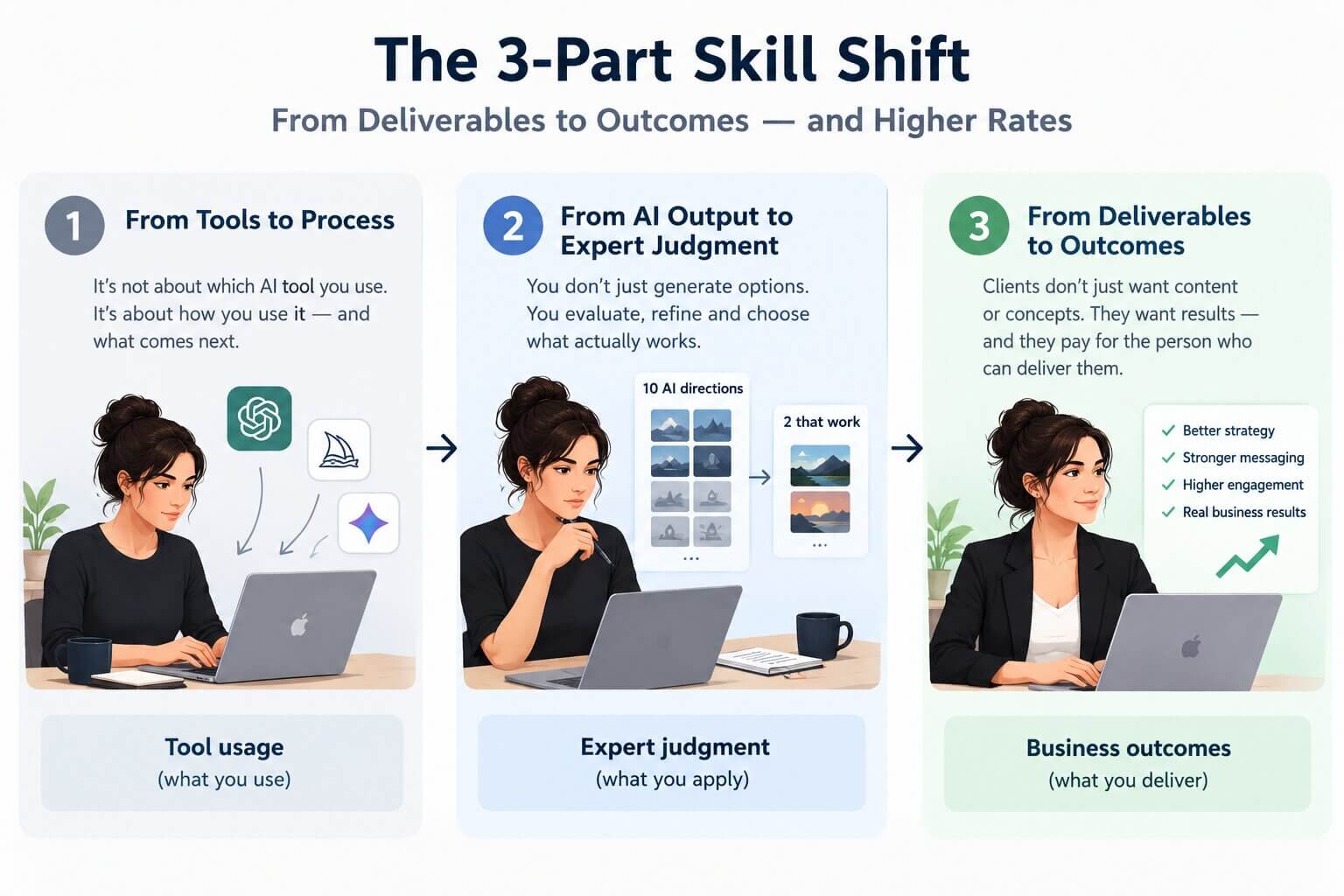
This is the actual shift. Not a tool. Not a course. Three changes in how you position and deliver your work.
1. From Deliverables to Outcomes
A $25/hr freelancer sells "a blog post" or "500 words." A $200/hr freelancer sells "traffic that converts" or "a landing page that lifts signups." Same underlying work, completely different pricing conversation — because outcome pricing isn't tied to hours.
Here's why that math matters so much. Say a task used to take you 4 hours at $25/hr — that's a $100 job. AI cuts it to 1 hour. If you're still billing hourly, you just invoiced yourself down to $25. If you'd priced that same job at $150 for the outcome instead, AI just turned it into a $150-an-hour job. Same work, same AI tool, completely different result — because one pricing model punishes you for getting faster and the other rewards you for it.
2. From Generic AI Literacy to Vertical-Specific Tool Fluency
There's a real difference between "I took a course on AI for freelancers" and "I know exactly which AI research tool a medical writer needs, or which AI scheduling tool a construction project manager uses." Generic AI skills are common and getting cheaper by the month. AI fluency stacked on top of real experience in your actual field — writing, design, marketing, bookkeeping, whatever you already do — is rare, and rare is what gets paid.
A copywriter who's spent five years writing SaaS case studies and now uses AI to speed up research and first drafts is worth more than someone who's only ever learned "how to prompt." The AI didn't replace the five years of experience. It multiplied it.
3. From Invisible Process to Visible Proof
The $200/hr freelancers make their AI-assisted process part of the pitch. Not "I used ChatGPT" — nobody cares, and honestly it can read as a red flag if that's all you say. Something concrete instead: "I generate 10 structural directions with AI, then apply 8 years of brand strategy to narrow it down to the 2 that will actually work for your audience."
That one sentence does more for your rate than any tool subscription ever will. Clients aren't paying for the AI. They're paying for the judgment that tells good AI output apart from confidently wrong AI output — and if they can't see that judgment happening, they assume there isn't any.
How to Make This Shift If You Only Have 5 Hours a Week
If you've got a full-time job and you're doing this on the side, all of the above probably sounds great in theory and impossible in practice. You don't have a spare afternoon to rebuild your entire freelance business. Fair. Here's the realistic, 5-hours-a-week version.
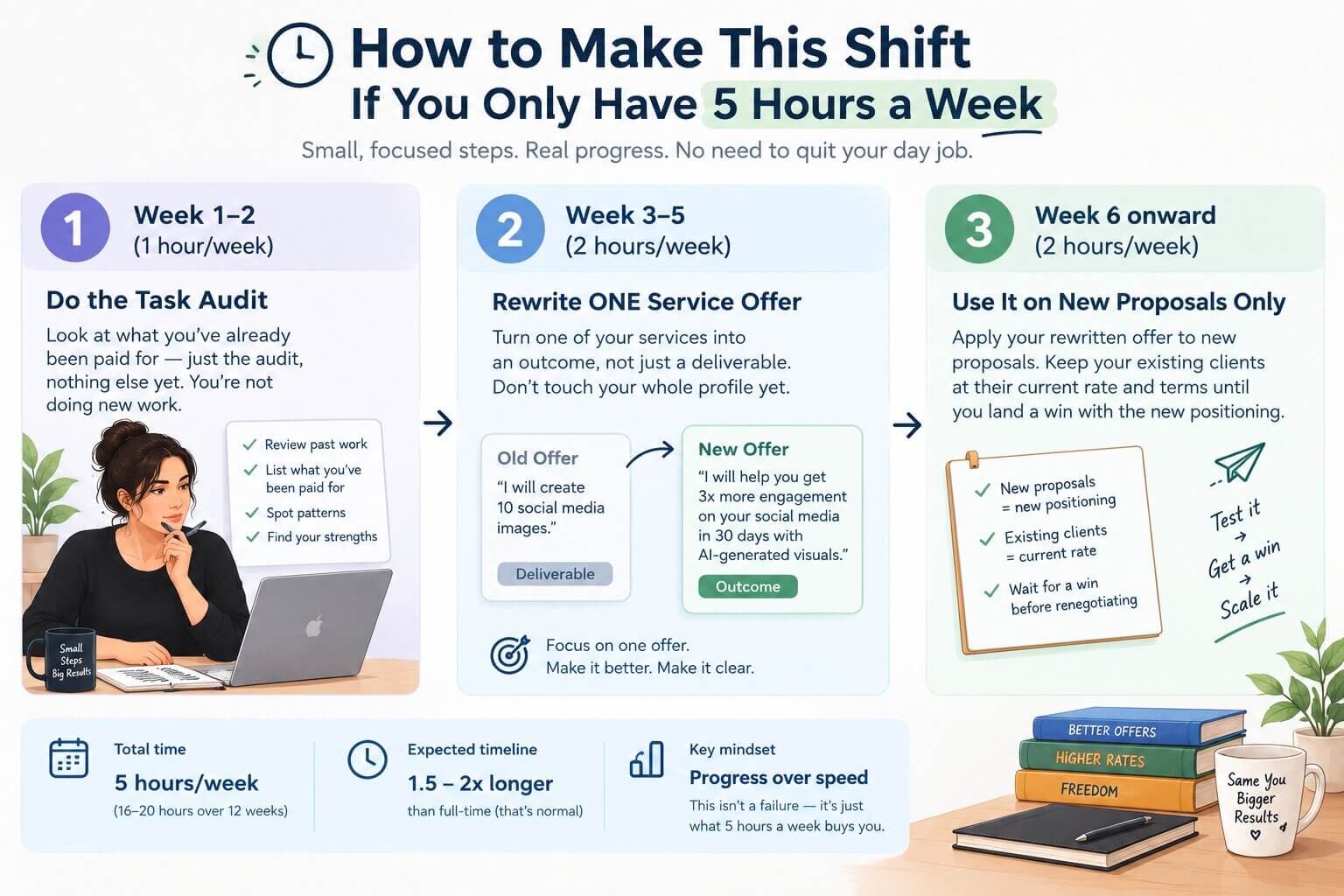
- Week 1–2 (1 hour/week): Do the task audit below — just the audit, nothing else yet. You're looking at what you've already been paid for, not doing new work.
- Week 3–5 (2 hours/week): Rewrite ONE service offer around an outcome instead of a deliverable. Just one. Don't touch your whole profile yet.
- Week 6 onward (2 hours/week): Use that rewritten offer on new proposals only. Keep your existing clients at their current rate and terms until this new positioning has actually landed you a win — you don't want to renegotiate a real relationship based on something untested.
One honest note: this part-time pace means the timeline in the next section runs about 1.5–2x longer than it would full-time. That's not a failure of the method — it's just what "5 hours a week" actually buys you. Don't compare your month 2 to someone doing this 30 hours a week.
How to Actually Start This Shift This Week
- Audit your last 6 months of paid work, task by task. For every task a client paid you for, ask: could a decent AI tool produce a commercially usable version of this in under 10 minutes? If yes, that task is heading toward $25/hr territory whether you like it or not. If no — because it needs your judgment, your relationships, or expertise AI can't fake — that's where your future rate actually lives.
- Rewrite one service offer around the outcome. Instead of "I write blog posts," try "I write content that ranks — here's what happened to [a past client]'s organic traffic." You need one real result to point to. Don't invent one; if you don't have a case study yet, name the outcome you're aiming for instead and be upfront that you're early.
- Pick ONE AI tool that fits the skill you already have — skip the generic course. A copywriter needs an AI drafting/research tool. A designer needs an AI concept-generation tool like Midjourney. Going straight to the tool that speeds up what you're already good at beats a broad "AI for freelancers" bootcamp every time.
- Write one paragraph describing your process, not just your results. What you did, how AI sped up part of it, what judgment call you made. This single paragraph, added to your profile or your next proposal, does more for your credibility than a portfolio of finished pieces with zero explanation.
- Test the new pitch on new clients only. Keep current retainer clients at their existing rate until the contract naturally renews.
If you're still deciding whether to build this around services or package what you know into a product instead, this comparison is worth reading next.
What Can You Actually Expect in Month 1, Month 3, Month 6?
Here's where a lot of AI-earning content gets dishonest, so let's not do that. This shift doesn't take you from $25 to $200 in a month, and if anyone promises that, they're selling the course, not doing the work themselves.
- Month 1: You're mostly doing the audit and rewriting your offer. Most people see little to no rate change yet — maybe $5–$15/hr more on brand-new proposals only. That's normal, not a sign it isn't working.
- Months 2–3: With one solid case study or honestly-framed pitch, freelancers in writing, design, and marketing services typically start landing new work in the $50–$120/hr range. Not every proposal — but enough to notice the shift is real.
- Months 4–12, with consistent effort: $100–$250/hr is a realistic range for freelancers who've fully repositioned around outcomes and built a track record of a few wins. This matches what AI-augmented specialists are actually reporting on platforms in 2026 — it's not a hypothetical ceiling, but it's also not guaranteed just by trying.
If you're doing this part-time on 5 hours a week, stretch every one of those timelines by roughly 1.5–2x. That's the honest trade-off for keeping your day job.
One more practical note: Fiverr takes a 20% cut of what you earn. Upwork's fee slides from 5–20% depending on how much you've billed a given client over time. Outcome pricing matters even more here — a 20% platform fee stings a lot more on a $25/hr gig than it does on a $150/hr one.
Frequently Asked Questions
What to Do Right Now
Open a doc and list every task you got paid for in the last 6 months. Next to each one, write "AI could do this in 10 minutes" or "AI can't touch this." That list is the entire starting point for your next rate increase — not a new tool, not a certificate, just an honest look at what you're actually selling.
KEEP READING
Want the full path from your first AI dollar to a repositioned, higher-rate business?
See how AI has already reshaped Fiverr and Upwork, and where this skill shift fits into the wider AI earning roadmap.
Join the discussion
Sign in to leave a comment or reply
No comments yet
Be the first to share your thoughts!