
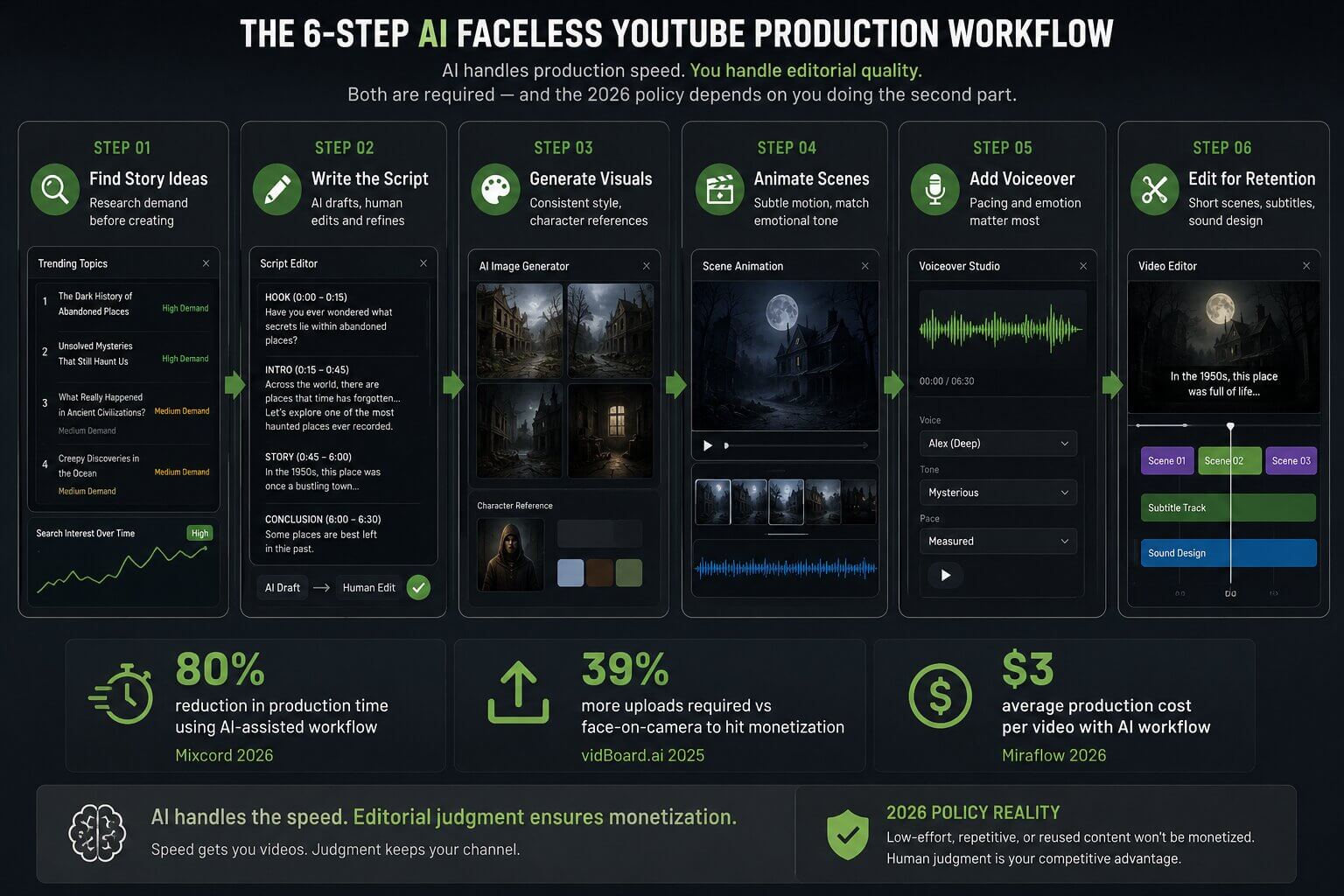
Faceless YouTube channels built entirely with AI are one of the most searched-for content models in 2026. And also one of the most misunderstood.
Most guides about this topic focus on the workflow — how to string together AI tools and start uploading videos. What they consistently leave out is the part that now determines whether your channel succeeds or gets demonetized within weeks: YouTube significantly tightened its content policies in July 2025, and thousands of faceless AI channels lost monetization as a direct result. Many of those channels were built following exactly the same advice most guides still repeat.
This guide covers the full picture — including the policy change, what it actually means for the way you produce content, and how to build a channel that earns rather than one that gets removed from the Partner Program before it ever pays out.
What a Faceless AI Animated Story Channel Actually Is
A faceless YouTube channel produces content without the creator ever appearing on camera. There is no talking head, no personal identity attached to the channel, and in many cases no real recorded voice either. The content — visuals, narration, music, pacing, emotional delivery — does all the work.
The creator operates entirely as a producer behind the scenes: deciding on story angles, overseeing scripts, directing the visual style, managing the publishing schedule, and making the editorial decisions that shape what the channel feels like to viewers.
AI has made this model dramatically more accessible than it was even two years ago. In 2022, faceless channels accounted for 12% of new creator monetization ventures. By 2025, that figure had reached 38% — and production costs have fallen to under $3 per video using a full AI stack. That is not an estimate; it is a documented benchmark from Miraflow's 2026 creator cost analysis.
The specific format covered in this guide is the AI animated story channel: where AI-generated imagery, AI animation tools, and AI voiceover are combined to tell narrative stories with a consistent visual style, recurring characters or settings, and a channel identity viewers can recognize and return to.
Examples of this format working at scale include channels built around animal rescue stories, horror and mystery narration, mythology and folklore, anime-style emotional fiction, and motivational real-world stories. Each uses a different visual style and emotional tone — but all follow the same fundamental production model.
The Opportunity in 2026: What the Real Numbers Show
The global creator economy is no longer a niche industry. Analysts project it to grow from $212.3 billion in 2024 to nearly $895 billion by 2032. Faceless channels are capturing a growing share of that expansion — but the distribution of success is not uniform. The channels that are growing in 2026 are built differently from the ones that grew in 2023.
Faceless Channel Growth: Share of New Monetization Ventures (2022–2026)
Source: AutoFaceless 2025 Industry Analysis / Mixcord 2026 / Miraflow 2026.
38%
of new creator ventures are now faceless channels
AutoFaceless 2025
217%
increase in monetization success vs 2022
Mixcord 2026
$3
average production cost per video with full AI stack
Miraflow 2026
80%
reduction in production time using AI workflow
Mixcord 2026
Loading chart…
Earning potential data reflects established channels (6+ months, 2–3 videos/week). New channels earn significantly less in months 1–3. Creator economy projected to grow from $212.3B in 2024 to $895B by 2032.
YouTube Shorts now generates 200 billion daily views — a 186% increase from 70 billion in March 2024. This matters for story channels because Shorts can function as a top-of-funnel for long-form content, and YouTube's 2026 monetization requirements offer a second path to eligibility through Shorts: 500 subscribers and 3 million Shorts views in 90 days.
The 72% of Gen Z viewers who say they care more about content quality than whether they can see the creator's face is the structural reason this model continues to grow. Younger audiences follow content, not personalities. Faceless channels that produce genuinely good content have the same organic growth potential as face-on-camera channels.
YouTube's 2026 Policy: What Every Creator Must Understand Before Uploading
On July 15, 2025, YouTube issued a significant update to its YouTube Partner Program policies. The update renamed the existing "repetitious content" policy to "inauthentic content" — and that renaming reflects a real shift in what the policy targets.
The practical impact was significant and immediate. In early 2026, thousands of faceless AI channels had monetization suspended. YouTube's AI detection systems can now identify patterns behind mass-generated videos — same template structure, same voice tone, same image generation style, same editing rhythm across every upload.
The important clarification, which YouTube published officially: faceless channels are not banned. AI-assisted content is not banned. What is banned from monetization is mass-produced, template-based content that lacks genuine creative input.
What "Inauthentic Content" Looks Like in Practice
- Near-identical videos uploaded in bulk — same format, same voiceover pattern, same visual template
- Robotic narration with no pacing variation, emotional delivery, or natural rhythm
- AI-generated scripts published without human editing, restructuring, or original perspective
- Image slideshows with minimal commentary — reading text over stock images with no original storytelling
- Mass production of content that could have been produced by anyone using the same AI tool with the same prompts
What Stays Monetizable
- AI voiceovers and narration used with editorial direction — pacing choices, emotional calibration, tone variation
- AI-generated or animated visuals used with consistent visual identity and human art direction
- AI-assisted scriptwriting where the creator edits, restructures, and adds original perspective
- Faceless channels with a clear editorial voice and distinguishable format identity
- Content that varies in format, length, story type, and approach across uploads
Best Niches for AI Animated Story Channels
Niche selection is the most consequential decision you make before producing a single frame of content. A well-chosen niche has three qualities: real audience demand, manageable competition, and monetization potential.
Animal Rescue and Wildlife Stories
Narrative animal rescue stories produced with AI-generated visuals are among the highest-performing formats in terms of view count relative to channel age. The emotional trigger — a dog rescued from a flooded shelter, a stray cat finding a home, a wildlife rehabilitation — is universally understood without explanation. This emotional accessibility translates directly into watch time, which is what the algorithm rewards most.
Horror and Mystery Narration
Horror content consistently produces strong retention metrics. Mr. Nightmare has built over 6 million subscribers telling scary stories with narration and atmospheric visuals. Dark, atmospheric imagery is where AI image generation performs particularly well. The voiceover pacing is the most critical variable: slow, deliberate delivery with deliberate pauses builds tension.
Mythology and Ancient Folklore
Mythology channels combine storytelling with implicit educational value. Content in this category tends to be genuinely evergreen — a well-produced video about Greek mythology or Japanese legend remains discoverable and relevant for years after publication. Popular angles include Greek and Roman mythology, African and Native American oral traditions, Japanese legends, Celtic stories, and Indian mythology.
Anime-Style Emotional Stories
Anime-inspired storytelling channels are growing rapidly in 2026, powered by improved AI tools for generating consistent anime-style visuals. The audience is large, global, and highly engaged. Popular formats include emotional slice-of-life stories, action and adventure narratives, coming-of-age fiction, and fantasy world-building.
Motivational and Underdog Story Channels
Story-based motivation performs measurably better than generic motivational quotes or slideshow content. An underdog narrative holds attention in a way that a quote over a sunset does not. This niche also has stronger advertiser interest than pure entertainment content, which means higher CPMs once the channel reaches meaningful scale.
AI Animated Story Niches — RPM Comparison
Source: virvid.ai / OutlierKit creator earnings analysis 2024–2025. RPM = creator take after YouTube's 45% cut.
Animal Rescue
Viral + emotionalLow competition, huge engagement.
Horror & Mystery
Strong retentionDark visuals = AI strength.
Mythology
Evergreen trafficEducation + storytelling combo.
Anime Stories
Fast-growingLoyal, large global audience.
Motivational
Higher CPMsStory beats quotes every time.
Loading chart…
Horror stories earn $8–13 RPM per virvid.ai (Mr. Nightmare: 6M+ subs, 1.6B+ views). Finance niches command highest RPM but require more perceived authority.
Setting Up Your Channel Correctly From the Start
Channel setup decisions made in the first week affect discoverability, brand coherence, and growth trajectory for months.
Channel name
Choose a name that reflects the niche, not your personal identity. Something that tells a viewer immediately what kind of content they will find: "The Rescue Chronicles," "Forgotten Legends," "Shadow Stories." Avoid generic names like "StoryTime AI."
Channel description and about page
Write a clear, keyword-rich description of what your channel covers. Include the main topics, the emotional tone, and who the channel is for. This text is indexed by both YouTube and Google search.
Channel art and branding
Your banner image, channel icon, and thumbnail style should be visually consistent from the first upload. Decide on a color palette, a type treatment for titles, and a visual framing approach for thumbnails — and use it consistently.
Playlist structure
Organize your content into playlists from the beginning. Playlists extend watch time by auto-playing related content, and they signal to the algorithm that your channel has organized, thematic depth.
The 6-Step AI Production Workflow
The goal of an AI-assisted production workflow is not full automation. Full automation is precisely what YouTube's 2026 policy change targets. The goal is faster production with genuine quality, where AI handles the technical heavy lifting and you make all the editorial decisions.
Here is what a repeatable weekly system looks like from idea to upload, built for a creator producing 2 to 3 videos per week.
Story Research and Idea Selection
The most common mistake in AI story channel production is skipping this step entirely — generating a story based on personal interest without checking whether an audience is actively looking for it. Research takes 30 minutes per video idea and dramatically improves the chance that each video gets discovered.
Where to find proven story angles
- Search YouTube directly for your niche keyword and look at the top-performing videos. Identify the emotional angle, format length, and pacing that the audience rewards.
- Read the comments on high-performing videos in your niche. Comments are the most direct signal of what viewers felt, wanted more of, or felt was missing.
- Use Google Trends to verify whether a topic has stable or growing interest. A mythology story with consistent search volume over two years is safer than a trending topic that spikes and disappears.
- Browse Reddit communities in your niche. Subreddits surface real audience conversations — the emotional language your viewers use and the specific types of stories they love.
Script Writing — Where the Human Work Happens
This is the most important step in the entire production chain. A script that is purely AI-generated, published without significant human editing, produces content that feels generic. Generic content does not hold viewers. Poor watch time means the algorithm does not promote the video.
Use AI to draft the initial outline and the first pass at narration. Then do the editorial work: rewrite the hook yourself, cut anything that feels like padding, and ensure every scene is earning its place in the story.
The script structure that works for story channels
Hook — first 15 to 30 seconds
Start in the middle of tension, not at the beginning of the backstory. Viewers decide in the first 15 seconds whether they are staying.
Problem and escalation
Introduce the character's situation and the obstacle in front of them. Then make it worse before you resolve it. Audiences stay engaged when they are genuinely uncertain how a situation will resolve.
Emotional peak
The moment where the stakes feel highest. This is where the voiceover delivery, the music, and the visual pacing all need to align.
Resolution
Complete the story in a way that feels satisfying. The ending is what viewers carry with them, and what determines whether they click on the next video.
Visual Generation With Consistent Style
Consistent character design and visual style across all scenes — and across all videos on the channel — is what separates a professional-feeling channel from one that looks like a random collection of AI images.
Before generating a single scene, create a visual style document and a character reference sheet. The style document defines your art direction: color palette, lighting approach, level of realism or stylization.
AI tools for image generation
- Leonardo AI: strongest character consistency controls. Good free tier. Best choice for beginners.
- Midjourney: most visually sophisticated output. Requires subscription. Best for established channels that know their visual direction.
- Flux (Flux Pro / Flux Ultra): excellent photorealism. Particularly strong for animal rescue and motivational content.
- Ideogram: better than most tools at handling text within images — useful when a story involves signs or on-screen text.
Animation and Motion — Making Stills Come Alive
Static images with narration over them no longer perform competitively on YouTube. The platform's audience has years of conditioning from high-quality video, and static slideshows consistently have lower retention than content with visual movement.
AI animation tools are now the standard solution for faceless animated channels. The leading options in 2026 are Runway Gen-3, Kling AI, PixVerse, and Luma AI.
What to animate and how
- Camera movement: a slow push toward the character during an emotional beat, a wide pull-out on a revelation. This is the simplest and most consistently effective form of animation.
- Environmental motion: moving clouds, rippling water, swaying foliage, flickering light. These background elements make scenes feel alive without requiring complex character animation.
- Character micro-motion: a slight turn of the head, a change in expression. AI tools handle subtle movements better than large-scale character motion.
- Match motion to emotion: a tense scene needs slow, controlled camera movement. A resolution scene benefits from wider framing. These are editorial decisions the AI tool will not make for you.
Voiceover and Audio — The Most Underestimated Variable
Voiceover quality is one of the most important factors in whether a viewer stays or leaves. If your voiceover sounds like a default text-to-speech output, your channel looks like exactly the kind of low-effort automation the 2026 policy targets.
Tool selection
- ElevenLabs: produces the most natural-sounding output, with the strongest emotional range and the most control over pacing and delivery style. Has a free tier and paid plans.
- PlayHT: strong second option with good voice variety and natural delivery.
- CapCut AI voices: built into the editing tool, reducing friction. Quality is acceptable for some niches but falls short for horror and emotional story content.
Sound design
Add ambient sound and music under every voiceover. For horror: dark atmospheric music, distant environmental sound. For animal rescue: warm instrumental tracks, soft ambient nature sounds. For mythology: orchestral underscore. Sound design is what makes the difference between a video that feels cold and one that feels genuinely immersive. Suno AI, Musicfy, and Epidemic Sound all have options suited to story channel content.
Editing for Retention, Thumbnails, and Publishing
Retention editing principles
- Keep scene lengths short. Most scenes in well-performing story channels are 3 to 8 seconds before cutting to the next image. Scenes that hold on a single static image for more than 10 seconds consistently drop retention.
- Use subtitle overlays throughout. On-screen text synchronized to narration increases retention — particularly for mobile viewers and viewers watching without sound.
- Use sound as punctuation. A subtle impact sound at a key revelation. A silence before a horror moment. Audio cues guide attention and emotional response in ways that visuals alone cannot.
- Match edit pace to narrative pace. Action and tension sequences benefit from faster cuts. Emotional resolution benefits from slower, wider shots held longer.
Thumbnails
Your thumbnail is the primary factor that determines whether someone clicks on your video. Create your thumbnail before finalizing your title — the two should work together as a single marketing unit. Strong contrast, bold typography, and an emotionally communicative face or scene all outperform abstract thumbnails across every niche.
Titles and metadata
Write titles that combine the searchable keyword with an emotional hook. For mythology: "The Greek God No One Talks About (And Why He Was Feared)" rather than "Ares — God of War." For horror: "The Abandoned Hospital Where 47 Nurses Disappeared" rather than "Scary Story — Abandoned Hospital."
Monetization: How to Earn Beyond AdSense
Most beginners treat YouTube monetization as a single thing: AdSense. That is a significant structural mistake — and the 2026 policy environment makes it a riskier one than ever. A single policy enforcement action can suspend AdSense revenue on a channel that depends on it entirely.
Smart creators treat YouTube as a distribution channel that drives traffic to their actual income model — not as the income model itself.
01 — YouTube Partner Program (AdSense)
The baseline revenue stream. YPP eligibility in 2026 has two paths: 1,000 subscribers plus 4,000 watch hours for long-form ad revenue, or 500 subscribers plus 3 million Shorts views in 90 days. Established animated story channels earning $2,800+/month from AdSense alone have portfolios of 50+ videos across 10+ months of consistent uploads. Plan for 3 to 6 months before meaningful AdSense revenue.
02 — Affiliate Marketing
The most natural second income stream and the one that can start generating revenue before YPP eligibility. If your channel covers mythology or history, promote books, documentary streaming services, or history courses. If it covers animal rescue, promote pet care products. If it covers AI production, promote the AI tools you actually use — ElevenLabs, Leonardo AI, Midjourney. Affiliate income from video descriptions can begin from your very first video.
03 — Digital Products
A natural extension once your channel has an audience who trusts your process. Prompt packs for the visual styles your audience loves. A documented step-by-step version of your production workflow. Story script templates. Canva thumbnail templates for your niche. These products solve problems your audience directly has.
04 — Sponsorships and Brand Deals
Become accessible earlier than most creators expect — sometimes before reaching 5,000 subscribers — if the channel is in a specific niche with a clearly defined audience. Brands pay for access to their target demographic, not for large but generic viewership.
05 — Channel Memberships and Patreon
Work well for story channels because viewers who love a channel's storytelling style want more of it. Exclusive early-access episodes, extended versions of popular stories, behind-the-scenes content, and community polls about which story to produce next consistently convert casual viewers into paying members.
The Complete AI Tool Stack
Simpler is better. Beginners who spend the first month evaluating every AI tool on the market rarely publish their first video. The stack below covers every step in the workflow and can be started with free tiers for most tools.
Monthly costs range from $47 for a budget setup using all-in-one tools to approximately $180 for a full specialist combination. The mid-tier sweet spot sits at around $78/month and delivers the best ROI for most story channels.
| Production Step | Recommended Tool | Free Tier? |
|---|---|---|
| Story idea research | Google Trends + YouTube Search + Reddit | Free |
| Script drafting | ChatGPT-4o / Claude | Free tier |
| Image generation | Leonardo AI / Midjourney / Flux | Yes / Paid |
| Animation & motion | Kling AI / Runway Gen-3 / PixVerse | Limited free |
| Voiceover | ElevenLabs / PlayHT | Yes (limited) |
| Music & sound | Suno AI / Musicfy / Epidemic Sound | Yes / Paid |
| Video editing | CapCut / DaVinci Resolve | Free |
| Thumbnail design | Canva AI / Adobe Express | Free tier |
| Analytics & research | TubeBuddy / vidIQ (free tier) | Free tier |
Start with this stack. Do not add more tools until you have published at least five videos and identified where the bottlenecks in your specific workflow actually are. The system matters more than the software.
Realistic Timeline and Income Expectations
The most common failure mode for new faceless channel creators is not lack of skill — it is running out of patience before the channel reaches critical mass.
Realistic Income Timeline — AI Animated Story Channel (2–3 videos/week)
Source: virvid.ai 2026 creator survey / Mixcord earnings benchmarks. Based on consistent uploads in mid-competition niches.
Loading chart…
YPP eligibility (1,000 subs + 4,000 watch hours) typically reached in months 3–5 with consistent uploads. Affiliate income starts earlier.
Individual results vary. Horror and true crime niches hit monetization 40% faster than lifestyle/motivation (virvid.ai 2026).
Horror and true crime niches hit monetization thresholds 40% faster than lifestyle or motivation content, according to virvid.ai's 2026 creator survey. That is because horror content consistently drives strong watch time and high click-through rates on thumbnails — the two metrics the algorithm weighs most heavily in early channel growth.
Mistakes That Kill Channels Early
Frequently Asked Questions
CONTINUE LEARNING
Ready to build the full system?
You have the production workflow. Now see how to structure the full automation system — niche research frameworks, channel scaling, and what it looks like to run this at $5,000/month.
Posted under: Earning With AI · How to Build YouTube Automation · Most Profitable YouTube Niches in 2026 · Selling AI Stock Images in 2026 · Why Most People Using AI Will Never Make Money
Join the discussion
Sign in to leave a comment or reply
No comments yet
Be the first to share your thoughts!