
⚡ Quick Answer
The biggest 2026 change is Comfy Desktop's full overhaul (renamed from ComfyUI Desktop, rolled out June 4–8, 2026) — multi-instance management, snapshots, and shared model storage. Other major updates: Krea2 and LTX2 video model support, official AMD ROCm support on Windows, and NVFP4 GPU performance upgrades. This page is accurate as of ComfyUI v0.27.0 (June 30, 2026) and gets updated as new versions ship.
ComfyUI ships new versions almost every week. If you updated recently and something looks different — a renamed app, a new tab, a node you've never seen — this page walks through everything new, in plain English.
Is ComfyUI Still Being Actively Updated in 2026?
Yes — more actively than most tools you'll use. Releases ship roughly every two to four weeks, each adding new model support, new nodes, and bug fixes. The rest of this page groups those releases into the changes that actually affect how you use ComfyUI day to day.
v0.20.3April 27, 2026Partner node updatesv0.23.0June 1, 2026New open-source model supportv0.27.0June 30, 2026int8 model supportComfy Desktop Was Renamed — Here's What Changed
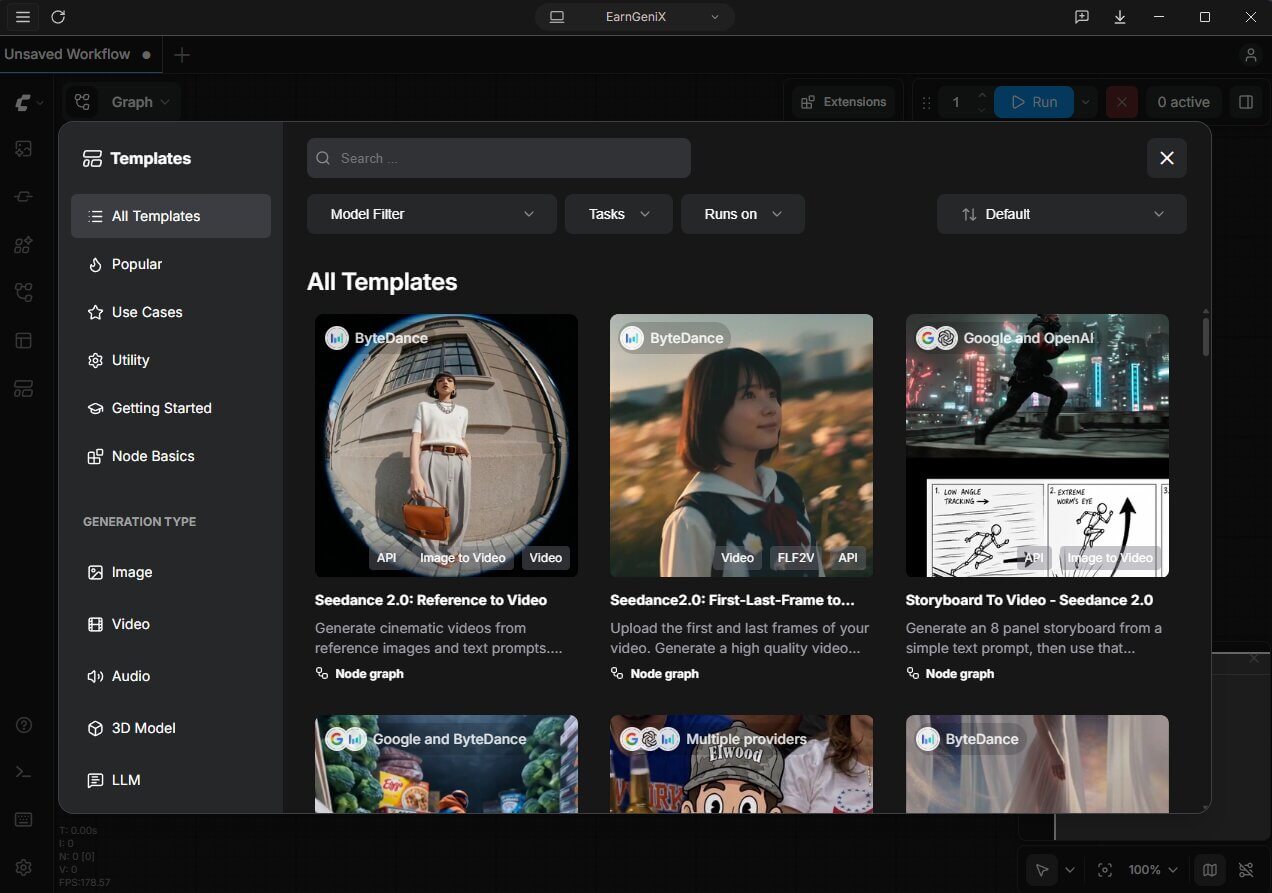
The desktop app previously called "ComfyUI Desktop" is now Comfy Desktop. The update rolled out gradually to existing users starting June 4, 2026, and reached everyone by June 8. If your app icon or window title looks different after an update, this is why — nothing about your install broke.
Comfy Desktop isn't just a rename. It turns the app into a management layer that can run and organize multiple separate ComfyUI installs, similar to tools like Stability Matrix.
What Is Multi-Instance Management?
Multi-instance management lets you run more than one ComfyUI setup from the same app, each with its own version, custom nodes, and settings. This matters if you need to test a workflow on an older ComfyUI version while keeping your main install on the latest release — you no longer need two separate app installs to do that.
What Are Snapshots and Why Do They Matter?
A snapshot saves the complete state of a ComfyUI install — version number, installed custom nodes, and Python packages — so you can roll back to it later. Before installing a custom node you're unsure about, take a snapshot. If the install breaks something, restore the snapshot instead of troubleshooting from scratch.
Do I Need to Reinstall to Get Comfy Desktop?
No. If you already had ComfyUI Desktop installed, the update applied automatically — you don't need to download or reinstall anything. Manual, portable, and Stability Matrix installs aren't converted automatically, but you can add them to Comfy Desktop as Tracked instances to manage them from the same app, without losing your existing setup.
For a from-scratch install, follow the full ComfyUI installation guide — it now installs Comfy Desktop by default.
What New AI Models Does ComfyUI Support in 2026?
Krea2 (Open-Weight Image Model)
Krea2 landed in ComfyUI as an open-weight model pair: RAW, for training your own LoRAs, and Turbo, for fast 8-step inference. Krea2 is known for a wide, less "AI-generated" aesthetic range compared to earlier open models.
For exact VRAM requirements, node setup, and sample prompts, see the full Krea2 ComfyUI workflow guide.
LTX2 Video Support
ComfyUI added native support for LTX-2, plus LTX2 Context Windows, which lets the model sample longer video sequences without running out of memory, and IC-LoRA guide splicing for more controlled outputs.
See the LTX2 workflow guide for the full node setup.
Other New Partner Models
ComfyUI's "partner node" system — official integrations with commercial and closed models — expanded in 2026 to include Nano Banana 2 Lite (Google), GPT-5.5 and GPT-5.5-pro, and Ideogram JSON prompt support through the new Bounding Box Canvas node. These run through API calls rather than local weights, so they need an API key from the provider — they don't require extra VRAM on your machine.
What Performance Improvements Landed in 2026?
NVFP4 Quantization, Async Offload & Pinned Memory
These three features work together to make ComfyUI faster on NVIDIA GPUs. NVFP4 quantization shrinks model file size and memory use by storing weights in a lower-precision format. Async offload moves parts of a model between VRAM and system RAM in the background instead of pausing generation to do it. Pinned memory speeds up that transfer by reserving a fixed block of system RAM for it. Together, they mean less waiting and lower peak VRAM use, especially on video workflows.
AMD ROCm Official Windows Support
AMD GPU owners previously had a rough time running ComfyUI on Windows — ROCm (AMD's equivalent to NVIDIA's CUDA) worked reliably on Linux but not officially on Windows. That changed in 2026: ROCm now has official Windows support built into Comfy Desktop, so AMD GPU users on Windows no longer need a Linux dual-boot or WSL workaround to get proper GPU acceleration.
int8 Model Support for Older GPUs
ComfyUI v0.27.0 added int8 model support, which works on Turing-generation GPUs and newer — that includes cards as old as the RTX 2060. If you're running an older or budget GPU, int8 models use less VRAM and run faster than the fp16 versions of the same model, at a small quality cost.
Smaller Interface & Workflow Updates Worth Knowing
A few smaller changes that don't need their own section but are worth knowing about:
Seed node
A dedicated node for managing seed values across a workflow, instead of setting the seed inside each sampler node individually.
ConditioningMultiply node
Lets you scale conditioning (prompt influence) values directly, without extra math nodes.
GLSL node updated to the ANGLE library
For anyone using shader-based nodes, this improves cross-platform rendering consistency.
Blueprint subgraph descriptions
A developer-facing addition that lets custom node authors document subgraphs directly in the API. Not something a beginner needs to touch, but it's part of why custom node quality has been improving.
How Do I Update ComfyUI to Get These Features?
If You're Using Comfy Desktop
- Open Comfy Desktop and click your instance in the sidebar. A dropdown with update options appears.
- Click Update. Comfy Desktop downloads the new version in the background — you'll see a progress bar in the bottom corner.
- Once it finishes, restart the instance from the same sidebar menu. The version number in the bottom-left corner updates to confirm the new release installed.
If You're on the Portable Version
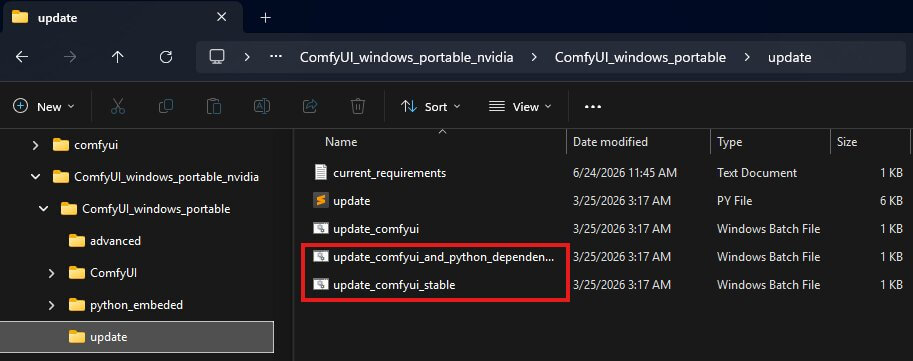
- Go to the
ComfyUI_windows_portable\updatefolder. - Double-click update_comfyui_and_python_dependencies. This updates ComfyUI to the latest version and updates all Python dependencies at the same time.
- If you don't want to touch Python dependencies — for example, if you've manually installed custom Python packages that a dependency update could break — double-click update_comfyui_stable instead. This updates ComfyUI without changing any Python packages.
- Restart ComfyUI once the update window closes.
Update Your Custom Nodes Too
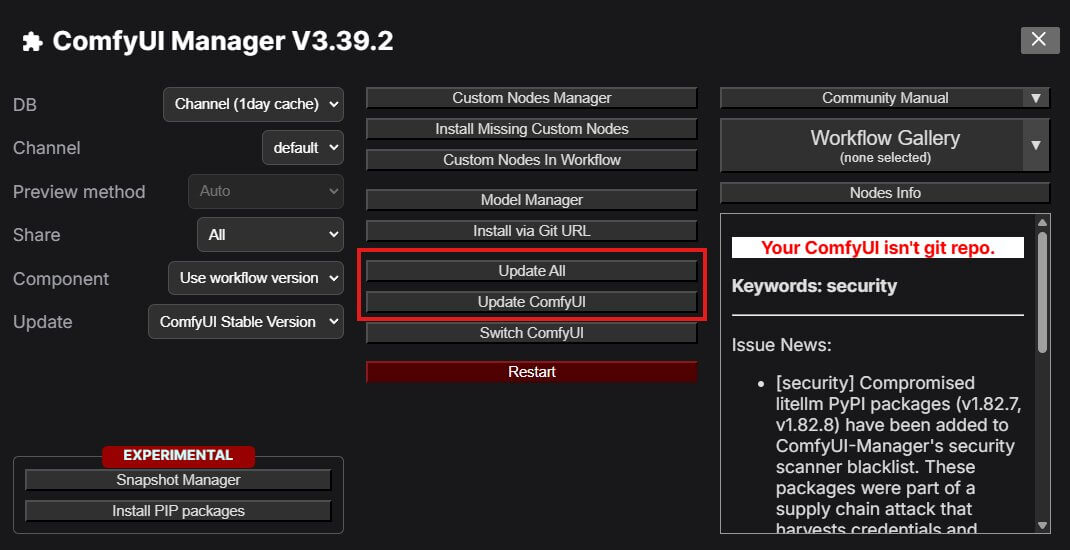
Updating ComfyUI itself doesn't update your custom nodes — that's a separate step. Open ComfyUI Manager and click Update All to bring every installed custom node to its latest version. Doing this right after updating ComfyUI prevents most of the version-mismatch red-node errors covered below.
If you haven't installed Manager yet, see the ComfyUI Manager installation guide first.
Troubleshooting
Nodes turn red immediately after updating
This is almost always a version mismatch — a custom node hasn't been updated to match the new ComfyUI release.
- Open ComfyUI Manager.
- Click Update All to update every installed custom node.
- Restart ComfyUI completely.
If a node is still red after that, see the full guide to fixing missing nodes in ComfyUI.
The Snapshot tab is missing for one of my instances
This happens when the instance was added as a Tracked install (manual, portable, or Stability Matrix) rather than a Standalone install. Snapshots currently only work on Standalone instances — this isn't a bug on your end, it's a current limitation of Tracked instances.
AMD ROCm isn't detected on Windows after updating
- Confirm you're running Comfy Desktop, not a manual install — ROCm Windows support ships through Comfy Desktop specifically.
- Update to the latest AMD GPU driver from AMD's website before updating ComfyUI.
- Restart your computer fully (not just the app) after the driver update, then reopen Comfy Desktop.
Frequently Asked Questions
What to Do Next
Update ComfyUI, then update your custom nodes
Update ComfyUI using the steps above, then open ComfyUI Manager and click Update All to bring your custom nodes in line with the new version. From there, the ComfyUI learning roadmap walks through every next step in order.
Published: 2026-07-04 · Last updated: 2026-07-04 · Accurate as of ComfyUI v0.27.0
Join the discussion
Sign in to leave a comment or reply
No comments yet
Be the first to share your thoughts!